

Prefrontal cortex: the brain's decision center
The prefrontal cortex is a major brain region involved in decision-making, planning, and behavior control. It activates when analyzing a situation, choosing between multiple options, or inhibiting an impulsive reaction.


The prefrontal cortex is a major brain region involved in decision-making, planning, and behavior control. It activates when analyzing a situation, choosing between multiple options, or inhibiting an impulsive reaction.
It organizes action, filters distractions, and helps maintain a goal in working memory.
However, its efficiency varies greatly depending on context. Its performance decreases notably in the presence of cognitive overload, mental fatigue, or an overly stimulating environment.
What strategies can help support and optimize prefrontal cortex function in daily life?
The prefrontal cortex: what does it actually do?
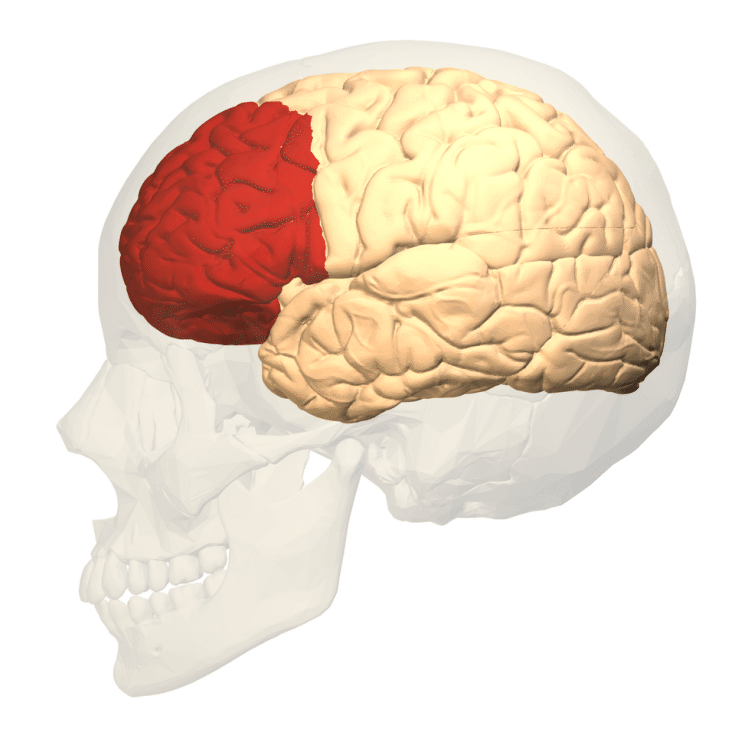
Image source: Wikimedia Commons
The prefrontal cortex is located in the most anterior part of the brain, behind the forehead. It is one of the most evolved structures in the human nervous system.
It is involved in situations where an action must be chosen voluntarily, taking into account multiple possible options and their consequences.
The prefrontal cortex participates in organizing goal-directed actions, structuring logical thought, and the ability to inhibit automatic reactions when they are not suited to the context.
The prefrontal cortex is the "control center" for complex behaviors.
How does the prefrontal cortex make decisions?
The brain gathers elements present in the situation to understand the context. Multiple choices are generated and compared in parallel to identify alternatives. Each option is evaluated based on its possible short- and medium-term effects. The brain selects the option most consistent with the goal and situation.
The prefrontal cortex acts as a permanent sorting and arbitration system.
These regulation and arbitration processes rely on brain activity, which can be modulated through approaches such as neurofeedback, according to evidence-based data published by the Association for Applied Psychophysiology and Biofeedback (AAPB).

Why does the prefrontal cortex fatigue so quickly?
The prefrontal cortex is heavily engaged on a daily basis. It is continuously involved in tasks requiring attention, reflection, and organization. This constant activity explains why it can become fatigued relatively quickly.
Its first limitation is its high cognitive energy consumption. Maintaining attention, processing information, and structuring a response requires sustained effort, even for seemingly simple tasks.
Certain situations accelerate this fatigue, including:
- multitasking, which forces the brain to constantly switch contexts,
- rapid succession of decisions, which heavily engages sorting and selection capacities
- the chronic stress, which disrupts the stability of its control functions.
The more it is continuously engaged, the more inefficient it becomes.
Prefrontal cortex and attention: why do decisions become unclear?

The prefrontal cortex depends directly on attention quality to function effectively. When this attention is unstable or excessively engaged, decision clarity progressively decreases.
- Distractions create decision overload. Each stimulus captured by the brain adds an additional micro-decision: should it be ignored, responded to, or given importance? On a large scale, this disrupts primary processing.
- When too many options are available at the same time, the prefrontal cortex must compare more possibilities, which naturally slows down the decision-making process.
- Mental fatigue also reduces the quality of information processing. With fewer resources available, the brain filters less effectively and decision clarity decreases.
- Interruptions break cognitive continuity. With each disruption, the brain must reorient itself, which weakens attentional stability and makes reasoning less fluid.
Decision quality depends on attentional stability.
Can the prefrontal cortex be trained?
The prefrontal cortex is not a fixed structure. Its capacities can strengthen or deteriorate depending on cognitive habits and lifestyle. This refers to brain plasticity—the brain's ability to adapt through training and repetition.
Several factors can support and improve its daily functioning:
- Sustained attention: voluntarily maintaining focus on a task without distraction trains the stability of attentional circuits involved in the prefrontal cortex.
- Structured tasks: with a clear objective, defined steps, and logical progression to strengthen mental organization and planning capacity.
- Repetition of simple decision-making: the brain gains efficiency when regularly confronted with quick and frequent choices.
- Cognitive recovery (rest, breaks): to allow the prefrontal cortex to restore its resources.
Prefrontal cortex and mental performance
The prefrontal cortex occupies a central position in overall cognitive performance. It acts as a control interface that organizes mental resources according to current objectives.
It is directly involved in attentional stability and the regulation of mental processes. When it functions efficiently, the brain is better able to filter distractions and maintain a coherent cognitive direction.
Its level of activation also influences several dimensions of daily performance, including the ability to stay focused, execute complex tasks, and maintain stable mental clarity over time.
Optimizing this system can contribute to improving overall mental performance.
Conclusion
The prefrontal cortex plays a central role in decision-making, attention management, and behavioral organization. It enables analysis, arbitration, and choice, but its capacities remain limited.
When it is overtaxed by fatigue, multitasking, or cognitive overload, its efficiency decreases rapidly. Conversely, when conditions are structured and demands are controlled, it functions more stably and effectively.
In a mental performance approach, the challenge is therefore not to increase the amount of effort, but to reduce the interferences that disrupt its functioning.
The neurofeedback services offered at Neuroperforma are provided under the supervision of psychologists who are members of the Ordre des psychologues du Québec (OPQ). An individual assessment is conducted prior to any intervention protocol. The information contained in this article is for educational purposes and does not constitute personalized professional advice.


