

Mental fatigue and mood: the frequently observed link
Persistent mental fatigue and low mood often share common neurological mechanisms. Learn more about this connection to take targeted action.


Feeling mentally drained in the middle of the day, noticing your mood darkening for no apparent reason… This scenario comes up often, even though the connection between the two symptoms isn’t always obvious.
According to Public Health Agency of Canada, mood disorders are among the most frequently reported mental health issues in the country. Yet this is no coincidence: mental fatigue and mood fluctuations share common neurological mechanisms.
The AAPB’s recognition of neurofeedback as a level 5 intervention applies to depression and does not directly extend to isolated mental fatigue. For the latter, neurofeedback can be considered – following an individual assessment – as a complementary avenue to address this connection rather than an isolated symptom, under the supervision of an OPPQ member psychologist.
Why are mental fatigue and mood so often linked?
The brain operates like a limited energy system – much like a battery that recharges overnight and gradually drains throughout the day. Every cognitive task (concentration, emotional management, or decision-making) draws on resources that must be constantly regulated. When this regulation becomes inefficient, mental fatigue sets in, long before a person notices any shift in their mood.
Mental fatigue and mood are often linked because:
- Imbalanced brain activity requires more effort to accomplish the same tasks as before.
- Chronic overload progressively depletes available attentional and emotional resources.
- Mood, regulated by many of these same brain circuits, directly suffers the consequences.
According to hypotheses frequently discussed in research, the brain’s frontal regions – involved in both concentration and emotion regulation – are thought to be particularly sensitive to this overload, although this mechanism does not manifest in the exact same way for everyone. Insufficient activity in these areas often results in a combination of cognitive fatigue and mood shifts rather than a single isolated symptom.
Temporary fatigue vs. established imbalance: what’s the difference?
Everyone experiences days of mental fatigue, often following an intensive work period or a poor night’s sleep. This type of temporary fatigue usually resolves itself with rest and a few nights of quality sleep.
Established mental fatigue is characterized by several distinct signs:
- Fatigue that persists despite getting enough sleep;
- A progressive loss of interest in activities previously enjoyed;
- An unusual difficulty concentrating, even on simple tasks.
Spotting this distinction early on makes it possible to seek an evaluation before the fatigue-mood cycle becomes deeply rooted in daily life and the symptoms become harder to untangle.
Yet, many people live for months with this combination of fatigue and fluctuating mood before consulting a professional, most often attributing it to a period that is simply busier than usual.
What a QEEG assessment reveals in these situations
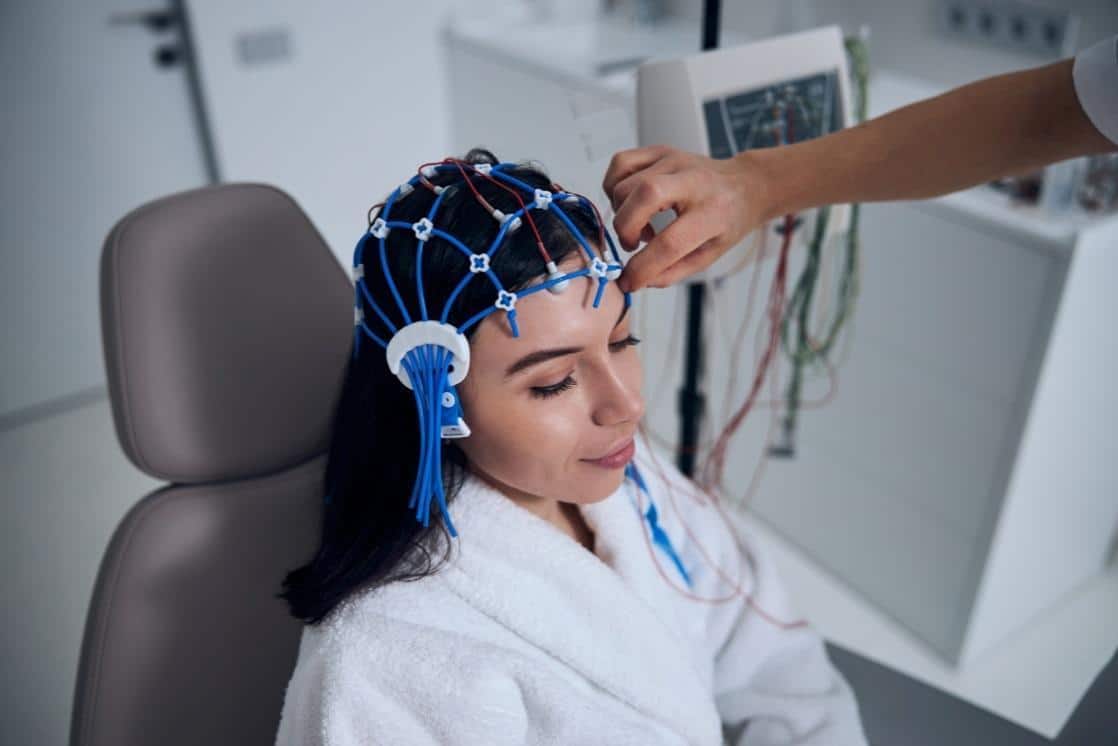
Fitting a QEEG cap before a brain activity assessment
A QEEG (quantitative electroencephalography) assessment measures the brain’s electrical activity. In individuals experiencing both mental fatigue and low mood, this test often reveals recurring patterns. These observations help better target the intervention rather than treating each symptom in isolation.
- Hypoactivity in certain frontal areas may be observed, sometimes associated with persistent concentration difficulties.
- Reduced connectivity between the frontal regions and the limbic system (which manages emotions) may also emerge from the assessment – presented as a descriptive hypothesis rather than a diagnostic finding.
- Brain wave patterns suggesting less efficient regulation of stress and mental recovery.
These neurological characteristics are observable and measurable, which distinguishes this approach from an assessment based solely on symptom questionnaires. However, they do not constitute a diagnosis in and of themselves. An individual evaluation is always necessary to properly interpret these results.
The role of sleep in this neurological cycle
Sleep plays a central role, as it serves as the primary window of recovery for an overloaded brain. Sleep that no longer fulfills its restorative function – even when total duration seems sufficient – deprives the brain of the recovery time needed to restore optimal functioning the following day.
- A non-restorative night keeps mood-regulation circuits in a state of continuous overload.
- Accumulated mental fatigue, in turn, makes falling and staying asleep more difficult.
- This cycle gradually closes in, reinforcing both fatigue and low mood as the weeks go on.
Neurofeedback and the fatigue-mood link
Rather than treating mental fatigue and mood symptoms separately, neurofeedback directly targets brain activity patterns. Neurofeedback is a brain-training technique considered an emerging practice by the OPPQ. It is not a cure, but rather a form of training aimed at improving the brain’s ability to self-regulate its functioning, rather than isolating a single symptom.
Depression – including forms that manifest primarily through fatigue and low mood rather than pronounced sadness – is ranked at level 5 by the AAPB, representing the highest level of evidence on its scale for neurofeedback interventions (see reference at the end of the article). This recognition is built on decades of clinical research, although results vary depending on each individual’s profile. However, this applies to depression and does not constitute direct proof of efficacy for isolated mental fatigue.
- A personalized protocol, built from the individual’s initial QEEG assessment.
- Progressive training aimed at improving the regulation of frontal circuits involved in energy and mood.
- Regular follow-up allowing the approach to be adjusted based on progress observed throughout the sessions.
Care supervised by an OPPQ member psychologist
At Neuroperforma, every journey begins with a structured interview conducted by a psychologist who is a member of the Order of Psychologists of Quebec (OPPQ), combined with a QEEG assessment, to properly identify the root cause of the observed imbalance.
This step helps determine whether neurofeedback is an appropriate avenue or if a referral to other resources is preferable depending on the situation. This professional framework distinguishes an intervention supervised by a psychologist from an unregulated approach, and also allows for the issuance of receipts recognized by several private insurance plans under the title of psychologist.
This combination of factors also explains why simply resting is not always enough to restore balance once the fatigue-mood cycle has taken root over several weeks or months.
FAQ
Can neurofeedback be considered following an evaluation if someone experiences mental fatigue without a depression diagnosis?
Yes, in many cases, isolated mental fatigue can be explored using this approach.
- An individual evaluation helps determine whether the observed brain patterns warrant a protocol.
- Neurofeedback does not necessarily require a formal diagnosis of depression to be considered.
- The goal remains to improve brain regulation rather than treat a specific diagnosis.
How long does it take to feel a difference in energy and mood?
Effects typically develop progressively over several weeks of regular sessions.
- The pace varies depending on the initial brain profile observed during the QEEG assessment.
- Some individuals report changes earlier, while others notice them later in the protocol.
- Results vary from person to person and cannot be guaranteed in advance.
Can poor sleep distort the results of a QEEG assessment?
Poor sleep can temporarily influence certain markers observed during the assessment.
- The clinical team takes the individual’s lifestyle context into account during the evaluation.
- The assessment reflects a snapshot at a given moment, not a measurement frozen in time.
- Regular follow-up allows the interpretation to be adjusted as sleep and energy levels evolve.
Do you need to stop taking antidepressants to start neurofeedback?
No, no medication changes should ever be made without discussing them with your attending physician.
- Neurofeedback can be considered as a complementary approach alongside existing pharmacological treatment.
- Any decision regarding medication remains entirely between you and your prescribing physician or psychiatrist.
- The goal of neurofeedback is not to replace medication, but to support brain regulation.
Does this fatigue-mood link affect certain types of people more?
Individuals exposed to chronic stress or high cognitive demand are particularly vulnerable.
- Demanding jobs that require sustained attention often increase the risk of entering this fatigue-mood cycle.
- Prolonged non-restorative sleep is also a significant vulnerability factor.
- An individual evaluation remains the best way to understand your unique profile.
Conclusion
Mental fatigue and mood fluctuations are not two separate issues, but rather two sides of the same neurological imbalance, often sustained by sleep that no longer fulfills its restorative function. Neurofeedback is recognized at level 5 by the AAPB for depression.
For mental fatigue, it can be considered – following an individual assessment – as a way to support brain regulation, under the supervision of an OPPQ member psychologist.
Recognize this link between mental fatigue and mood in your own life? Book a free consultation to find out how neurofeedback can help you →
Related reading: Mild depression and neurofeedback | Non-restorative sleep
This article is for informational purposes only. It does not constitute a diagnosis, medical advice, or personalized treatment recommendations. Neurofeedback is a brain-training technique (considered an emerging practice by the Order of Psychologists of Quebec); it does not replace a medical or psychological evaluation or follow-up. Results vary from person to person and cannot be guaranteed. If you are experiencing concerning symptoms, consult a qualified healthcare professional. At Neuroperforma, the process begins with an evaluation conducted by a psychologist who is a member of the OPPQ.
Reference: Association for Applied Psychophysiology and Biofeedback (AAPB), Evidence-Based Practice in Biofeedback and Neurofeedback – depression is listed among the applications classified at level 5 (efficacy established) for neurofeedback. This classification does not apply directly to isolated mental fatigue. Clinical results remain individual and variable.


