

Non-restorative sleep: why your brain won't unplug
Getting enough sleep but still waking up exhausted? Discover why your brain sometimes struggles to truly rest, and explore options to support it.


Seven or eight hours of sleep under your belt, and yet waking up feels more like a system crash than actual rest… The fatigue lingers, concentration is hard to come by, and irritability settles in right from the morning.
According to the Public Health Agency of Canada, one in five adults feels that their sleep is non-restorative. The length of your sleep is actually only part of the equation. Sleep quality – its architecture and restorative power – matters just as much, if not more.
When the brain remains in a state of hyperarousal even during sleep, it never truly manages to “unplug.”
Neurofeedback, documented by the AAPB as a probably efficacious approach for insomnia, offers a compelling avenue to better understand and address this phenomenon, under the supervision of an OPPQ member psychologist.
What is truly restorative sleep?
Restorative sleep is not limited to the number of hours spent in bed, even though duration remains important. It depends on the brain’s ability to properly cycle through the different stages of sleep, particularly deep sleep – also known as “slow-wave sleep” or delta-wave sleep – which plays a central role in physical and cognitive recovery.
- Light sleep allows for a progressive transition into deeper phases of rest.
- Deep sleep, dominated by delta waves, promotes physical recovery and memory consolidation.
- REM (rapid eye movement) sleep, associated with dreaming, contributes to emotional regulation and the processing of the day’s information.
When this architecture is disrupted – even without noticeable conscious awakenings – the brain does not fully benefit from the restorative effects associated with each phase, leading to persistent fatigue despite an apparently sufficient duration of sleep.
Why does the brain stay “switched on” at night?
Many individuals experiencing non-restorative sleep show daytime patterns consistent with hyperarousal during a QEEG (quantitative electroencephalography) assessment performed while awake and at rest – meaning brain activity remains higher than normal even when the person is resting. This phenomenon, sometimes referred to as “cortical hyperarousal,” prevents the brain from fully transitioning into the deep sleep phases necessary for complete recovery.
- Patterns often associated with hyperarousal in the literature (such as elevated beta activity), bearing in mind that a daytime QEEG does not replace a nighttime sleep study.
- An underrepresentation of slow waves (delta) can be discussed as a hypothesis related to poorly restorative sleep, to be confirmed based on the clinical context (as clinical QEEGs do not measure nighttime activity itself).
- Brain activity that remains reactive to surrounding stimuli, preventing truly complete rest.
This type of imbalance is often linked to a nervous system that remains in a state of vigilance – a state that can be sustained by chronic stress, anxiety, or a heavy mental load accumulated throughout the day.
This combination also explains why some people feel just as tired after nine hours of sleep as they do after a shorter night, as the quality of brain activity weighs heavily in the balance.
Daily signs to watch for
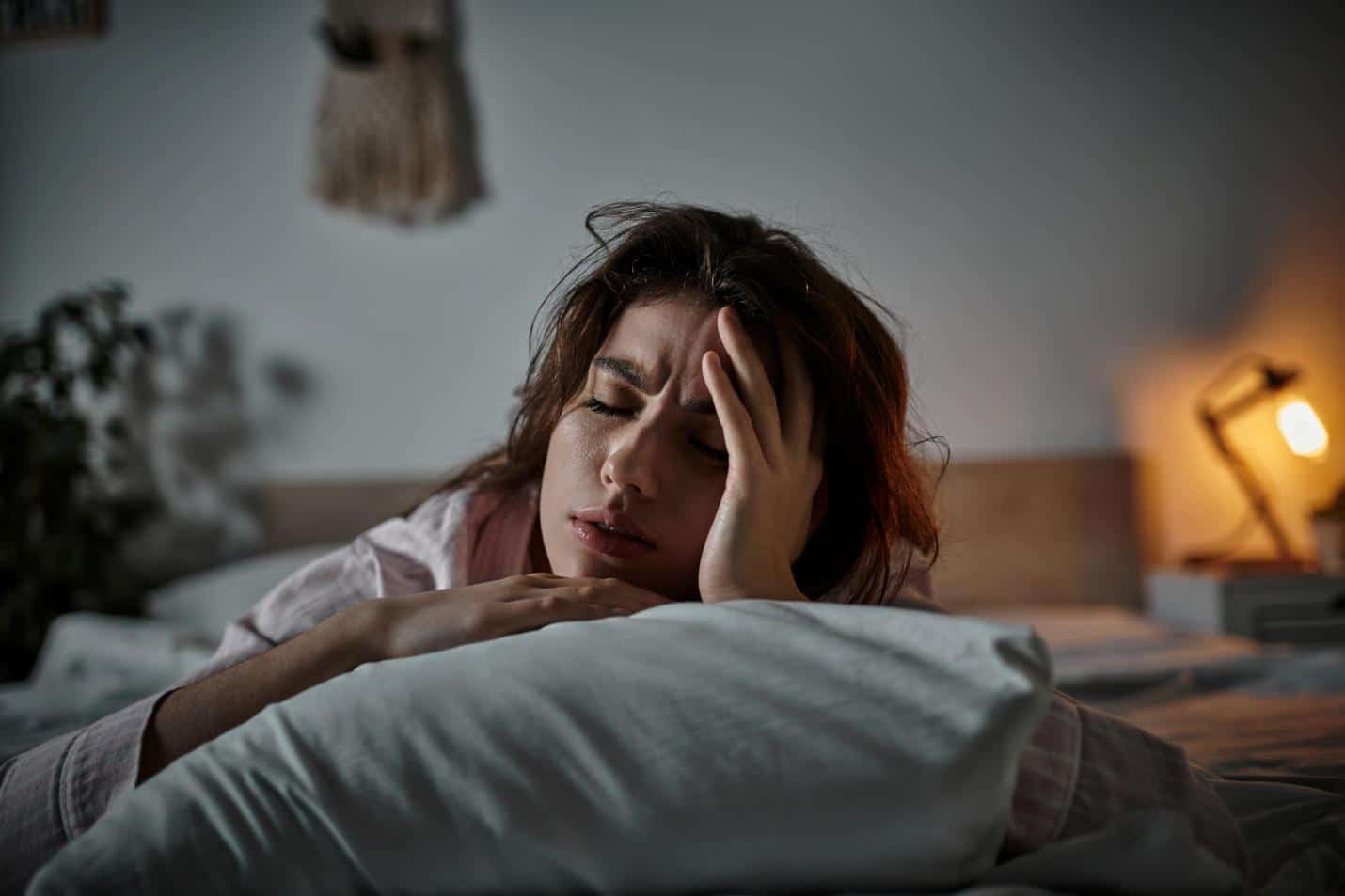
Woman in bed with her head in her hands, a sign of non-restorative sleep
Non-restorative sleep often manifests as a combination of signs that, taken individually, may seem harmless:
- Waking up feeling exhausted despite a normal night’s sleep, accompanied by persistent fatigue;
- A wave of drowsiness setting in during the afternoon, regardless of the day’s workload;
- Increased irritability or emotional sensitivity within the first few hours after waking up;
- Difficulty concentrating on tasks that previously required very little effort.
Recognizing this combination of signs makes it possible to seek an evaluation earlier, rather than simply writing off the fatigue as a lack of sleep. Some people live with these symptoms for years without connecting them to the actual quality of their sleep, looking instead to their workload or diet for explanations.
The role of neurofeedback in supporting non-restorative sleep regulation
Neurofeedback aims to train the brain to better self-regulate its activity, including the patterns that influence the transition into quality deep sleep. Rather than acting chemically to induce sleep, this approach relies on the progressive learning of improved cerebral self-regulation.
Insomnia and related non-restorative sleep issues are ranked at level 3 by the AAPB, placing them in the “probably efficacious” category. This level of evidence, distinct from the level 5 granted to depression, remains relevant within the framework of an individual evaluation and supervised protocol.
- An initial QEEG assessment, performed while awake and at rest, helps objectify the brain activity patterns specific to each individual.
- A personalized training protocol targets the frequencies associated with a smoother transition into deep sleep.
- Regular follow-up allows the approach to be adjusted based on reported changes in sleep quality.
Results vary from individual to individual and generally develop progressively rather than appearing immediately after the first few sessions.
The link to mental fatigue and mood
Non-restorative sleep rarely remains isolated for long. It frequently sustains a cycle alongside daytime mental fatigue and a gradually darkening mood – two symptoms that share common neurological roots with sleep disturbances.
Clinical supervision by an OPPQ member psychologist
Every journey begins with a structured interview conducted by a psychologist who is a member of the Order of Psychologues of Quebec (OPPQ), combined with a QEEG assessment, to better understand the factors unique to each situation. This step helps determine whether neurofeedback is a relevant avenue, or if a complementary referral – such as a consultation in sleep medicine – is also indicated.
This professional framework distinguishes an intervention supervised by a psychologist from an unregulated approach, and also allows for the issuance of receipts recognized by several private insurance plans under the title of psychologist.
FAQ
What is the difference between insomnia and non-restorative sleep?
The two concepts are related, but they do not always completely overlap.
- Insomnia generally involves difficulty falling asleep or staying asleep.
- Non-restorative sleep can occur even without any apparent difficulty falling asleep or staying asleep throughout the night.
- A person can sleep a normal number of hours while still experiencing non-restorative sleep.
How many sessions are required to improve sleep quality?
The number of sessions varies depending on the brain profile observed during the initial assessment.
- A protocol typically spans several weeks, with regular sessions scheduled throughout.
- The QEEG assessment helps guide the approximate duration of the recommended protocol for each individual.
- Results vary from person to person depending on consistency of follow-up.
Can poor sleep be caused solely by stress?
Stress is a major factor, but it is rarely the only cause of non-restorative sleep.
- A high mental load maintained over several weeks can sustain a state of cortical hyperarousal.
- Lifestyle habits, such as evening screen exposure, can aggravate the phenomenon.
- An individual evaluation helps identify the specific factors unique to each situation.
Is neurofeedback for sleep suitable for children?
This approach can be considered for certain young people, based on an appropriate clinical evaluation.
- Protocols and objectives generally differ from those established for adults.
- An initial assessment by a qualified professional remains essential before starting.
- Discussions with parents are an integral part of the evaluation process.
What should you do if non-restorative sleep persists despite good sleep habits?
It then becomes appropriate to consider a more thorough evaluation of brain activity.
- Good sleep habits remain essential, but they are not always sufficient on their own.
- A QEEG assessment, performed while awake and at rest, helps objectify brain activity and identify patterns consistent with hyperarousal.
- Consulting a healthcare professional also helps rule out other underlying causes.
Conclusion
Non-restorative sleep is not simply a question of duration, but rather the quality of sleep and brain recovery. When the brain remains in a state of hyperarousal, it never truly benefits from the deep sleep phases necessary for complete recovery. Neurofeedback, documented at level 3 by the AAPB for insomnia, offers a structured avenue to support this regulation, under the supervision of an OPPQ member psychologist.
Recognize yourself in this sleep that no longer truly restores you? Book a free consultation to find out how neurofeedback can help you →
Related reading: Mild depression and neurofeedback | Mental fatigue and mood
This article is for informational purposes only. It does not constitute a diagnosis, medical advice, or personalized treatment recommendations. Neurofeedback is a brain-training technique (considered an emerging practice by the Order of Psychologues of Quebec); it does not replace a medical or psychological evaluation or follow-up. Results vary from person to person and cannot be guaranteed. If you are experiencing concerning symptoms, consult a qualified healthcare professional. At Neuroperforma, the process begins with an evaluation conducted by a psychologist who is a member of the OPPQ.
Reference: Association for Applied Psychophysiology and Biofeedback (AAPB), Evidence-Based Practice in Biofeedback and Neurofeedback – insomnia is listed among the applications classified at level 3 (probably efficacious) for neurofeedback. Non-restorative sleep is not automatically equated with insomnia; the indication is clarified following an individual evaluation. Clinical results remain individual and variable.


